A deep dive into Machine Learning engineer’s competencies

Most prominent market leaders such as Microsoft, Apple, Google, Amazon and Univa have been making large investments in ML solutions, both for research and design purposes. The technology experiences enormous growth, which is astonishing even for experienced data scientists. It is no wonder that the role of machine learning engineer has correspondingly witnessed tremendous popularity among IT specialists.
In this post, we bring together the areas of knowledge that any ML engineer needs to master. We demystify the curiosity around the specialisation to shed light on what the role of a machine learning engineer entails. Without further ado, let us first illustrate the relevance of ML by a simple example.

Picture that the e-commerce company decided to hire data scientists to build predictive models. The specialists tackle the task and create the algorithm to recommend users items based on their search interests. Yet, at this point, the company cannot integrate the new feature into the platform; in other words, it struggles with implementing highly accurate and insightful algorithms due to a lack of skills in software engineering.
This is where machine learning specialists come into play. They bridge the discrepancy between the model development phase and its implementation, as they possess the necessary skill set of data scientists and software engineers. They know how to research, create and design AI systems of different complexity to harness expansive sets of data.
Machine Learning as a technology is an offshoot of AI, emphasizing algorithms’ self-education. The latter fosters the prediction of data patterns. Within the traditional ML, statistical instruments are combined with data, enabling predictions to be generated. Smart algorithms do the heavy lifting, and no manual code is needed. The result of ML work is omnipresent across the web, from Netflix recommendations to e-commerce, where machines analyse your preferences to provide tailor-made suggestions afterwards.
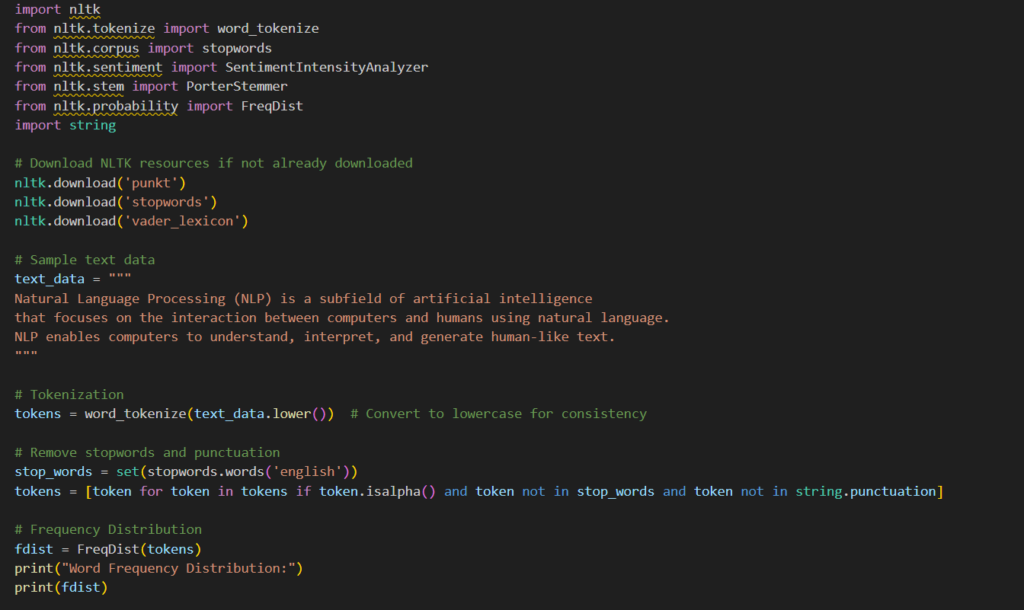


Most specialists are also expected to have expertise in object-oriented programming and, hence, follow the 5 principles of object-oriented design (SOLID) outlined by Robert C. Martin. These practices are widely used in Agile development and assist in preventing code refactoring. SOLID encompasses 5 principles: Single-responsibility Principle, Open-closed Principle, Liskov Substitution Principle, Interface Segregation Principle, and Dependency Inversion Principle. AI Developer Platform Weights & Biases або MLFlow for the end-to-end machine learning lifecycle.
The simplicity and rich variety of libraries made Python an appealing language for ML. Python proficiency is transferable to data analytics and web development projects. Java is also widely utilised for deploying ML models within the production environment: the language handles distributed and large-scale systems efficiently. Alongside this, knowledge of Java opens possibilities to work with big data technologies, namely Hadoop and Apache Spark. As for C++, this programming language is the most suitable for projects accentuating computational performance. C++ decreases the training time of deep learning models and provides more control over model optimisation. Tensorflow and Pytorc – far-famed ML frameworks – are both written in C++.
Experience with the PySpark DataFrame API, a tool that combines Python and Spark, will be an advantage for a technical specialist in the IT market.
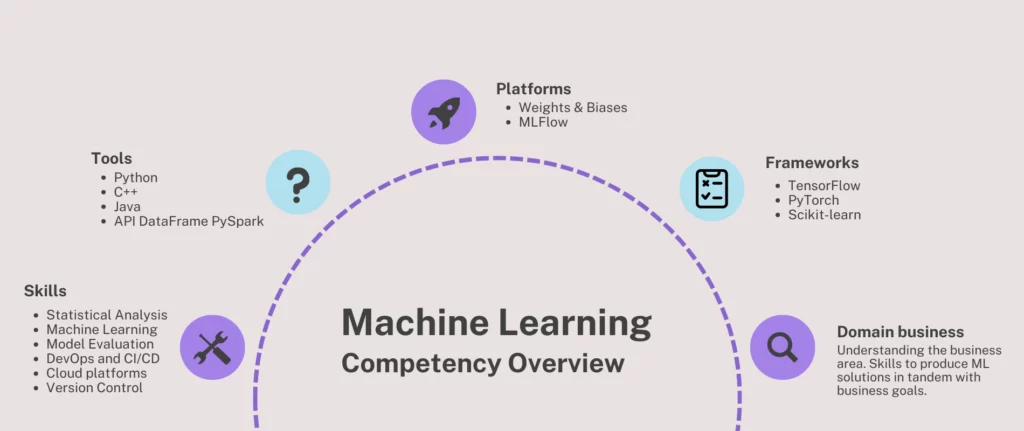
Proficiency in the TensorFlow, PyTorch and Scikit-learn frameworks for complex MN neural network models assists in the design and deployment of Convolutional Neural Networks (for example, image recognition) and Recurrent Neural Networks and Transformers (for text or audio analysis). Skills in using AI Developer Platform Weights & Biases or MLFlow for the end-to-end cycle of machine learning are also important.
The business domain knowledge is critical for technical specialists. The introduction of ML into business requires specialists to understand the conventional laws of a specific business area. Machine learning solutions development is a long and thorough process, which presupposes high financial expenses. The IT company and project developers are to identify and utilise relevant approaches and effective models to provide business with value. Understanding the potential customer’s business areas and combining business needs with machine learning technologies results in the development of practical solutions.
If you need consultation on implementing ML algorithms for your business, feel free to contact the PNN Soft team. Our 20+ years of experience and expertise in innovative technologies will assist you in empowering business solutions.